
Preserving memories, accessing knowledge
The Priest’s Notebook (SL0337)
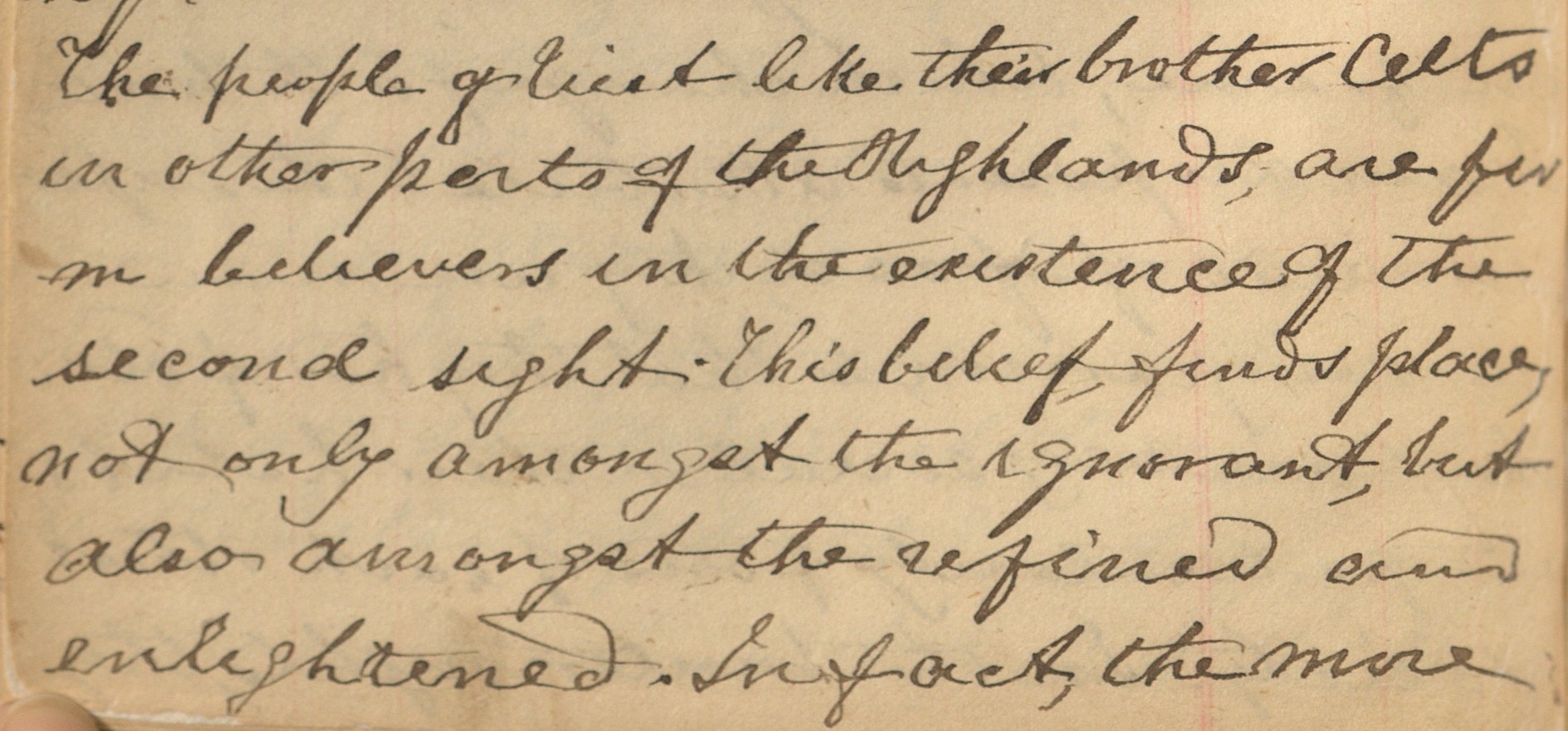
To mark the 280th anniversary of the Battle of Culloden which occurred on 16th April 1746, we turn to an intriguing object which was donated to Museum nan Eilean Lionacleit some years ago, namely a Priest’s Notebook.
The notebook dates to around 1890. It is anonymous, but we believe it was written by Father Alasdair Campbell, who was from South Uist and served at Bornish parish from 1870 until 1883.
Who was Fr Alasdair Campbell?
Acccording to this source, ‘When Fr Allan [MacDonald] first came to South Uist an old priest, Fr Alexander Campbell, a native of the island, was living in retirement at Dalibrog. Fr Campbell was a mine of information on the traditions of South Uist and it was probably he who interested Fr Allan in them. At any rate from 1887 on, once he was settled in and had mastered the local Gaelic dialect, Fr Allan kept a series of note-books in which he jotted down whatever of interest he heard and had time to record…’ (Alexander is the English form of the Gaelic name Alasdair).
As well as influencing and assisting the noted folklore collector Fr Allan, Fr Alasdair Campbell was also the source of several of the traditions and tales collected by Alexander Carmichael.
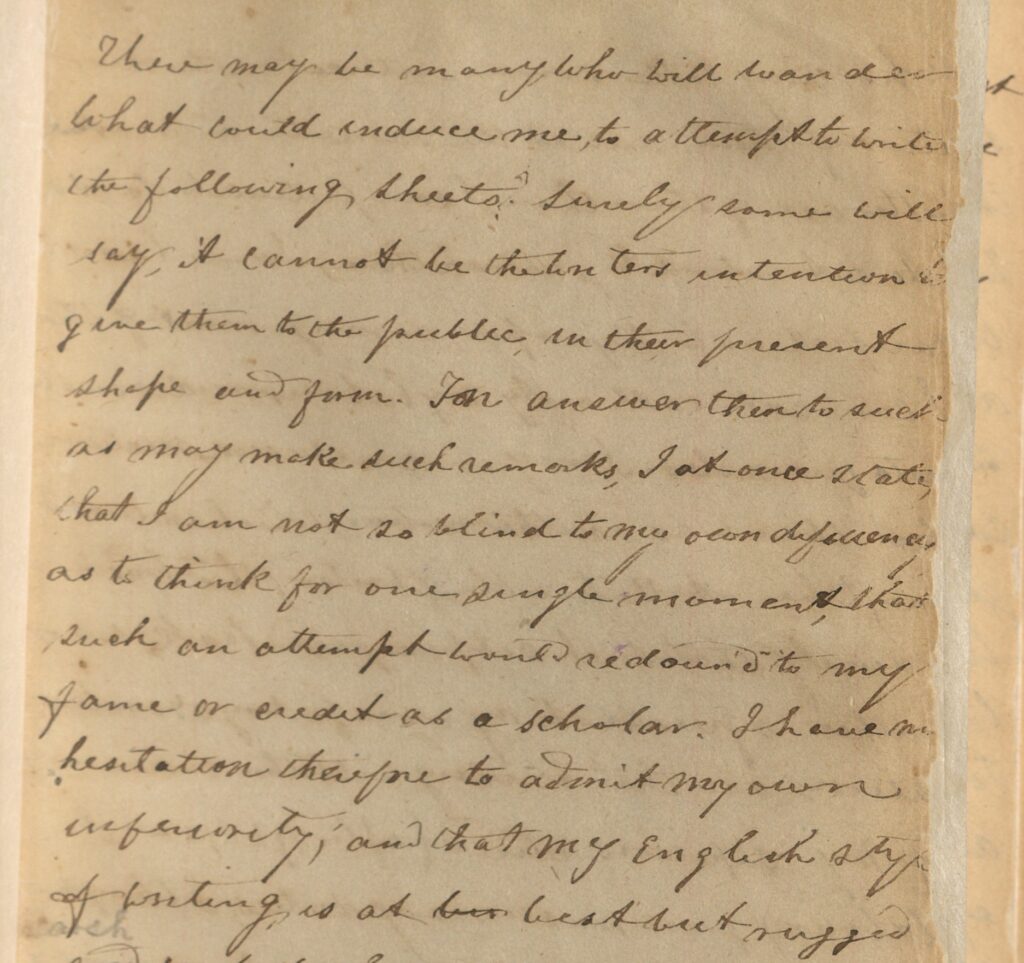
The notebook author writes about himself in the Preface:
‘There may be many who will wonder what could induce me to attempt to write the following sheets? Surely some will say, it cannot be the writer’s intention to give them to the public in their present shape and form. For answer then to such as may make such remarks, I at once state that I am not so blind to my own deficiency as to think for one single moment that such an attempt would redound to my fame or credit as a scholar. I have no hesitation therefore to admit my own inferiority; and that my English style of writing is at best but rugged and unpolished and in consequence unfit for publication. I disclaim then such intention and tell candidly that my only motive in writing the following memories is to preserve a few of the traditions of my native isle. Perhaps some may come after who may take some interest in the narration of them, and at the same time make better use of them than I can pretend to do. As I do not intend to publish them, I am less careful as to the proper arrangement of them… l may in conclusion mention that there was another motive, which induced me, to be at the trouble of writing these traditions, namely that such self imposed task, was rather agreeable to my own feelings and inclination: and that having with the consent of my superiors retired (after 42 years labour) from missionary duties, I thought I might employ the leasure [sic] I now enjoy in committing such events to paper.
‘It is very much to be regretted indeed, that a great deal of most valuable materials have had been lost, because none of the Clergy in charge then did not think proper to take the trouble of committing them to writing. Amongst these was the Christian doctrine in rhyme which could not fail to be now most valuable in the estimation of all Celtic scholars.’
What does the notebook contain?
The information in the notebook, which is more than 200 pages long, is wide-ranging. As one would expect, a lot of it deals with the ecclesiastical history of Uist and the post-Reformation history of the Highlands in general, including lists of all priests who served. As well as this, there is information on local folklore and legends such as mermaids, sea horses, second sight and so on. A whole chapter is devoted to the persecution of the Catholics of South Uist by Alexander MacDonald, Boisdale, and the subsequent emigration of some of the persecuted families to Prince Edward Island.
Due to the information about the 1772 emigration event, the notebook was identified for potential display in the 2025 exhibition ‘Cianalas ’s Dòchas | Homesickness and Hope Stories of Hebridean Emigration’. Before being displayed, however, it had to undergo conservation treatment, due to its condition. We describe the highly skilled conservation treatment, undertaken by archive conservators at Highland Archive centre in Inverness, in a separate article here. This conservation work was funded by donations collected at both our museums.
As well as conserving this valuable notebook, we have also fully digitised it, and will be making the digitised version available in due course. For now, as a taster, we share some fascinating extracts which relate to the aftermath of the Battle of Culloden in Uist. For more about the Jacobites, you can also visit The Scottish Diaspora Tapestry exhibition which is showing at Museum nan Eilean Lionacleit until 23rd May. The notebook is also featured in this exhibition.


