
Culloden: aftermath of the Battle in Uist
Some extracts from the Priest’s Notebook (SL0337)
As explained in our previous article, Preserving Memories, Accessing Knowledge, the Priest’s Notebook is a highly intriguing artefact which was donated to Museum nan Eilean some years ago. This article details extracts which refer to the aftermath of the Battle of Culloden and what it meant for the people of Uist. This is only one of the topics covered in the notebook.
‘Chapter 4th List of Missionary Priests
32. There was another priest of the name of John MacDonald, a contemporary of Mr Forrester. He was taken from this Island as prisoner and banished along with Mr Forrester by the soldiers of the bloody Duke of Cumberland. I am not aware that he ever came back to Scotland, at any rate he never came back to Uist.
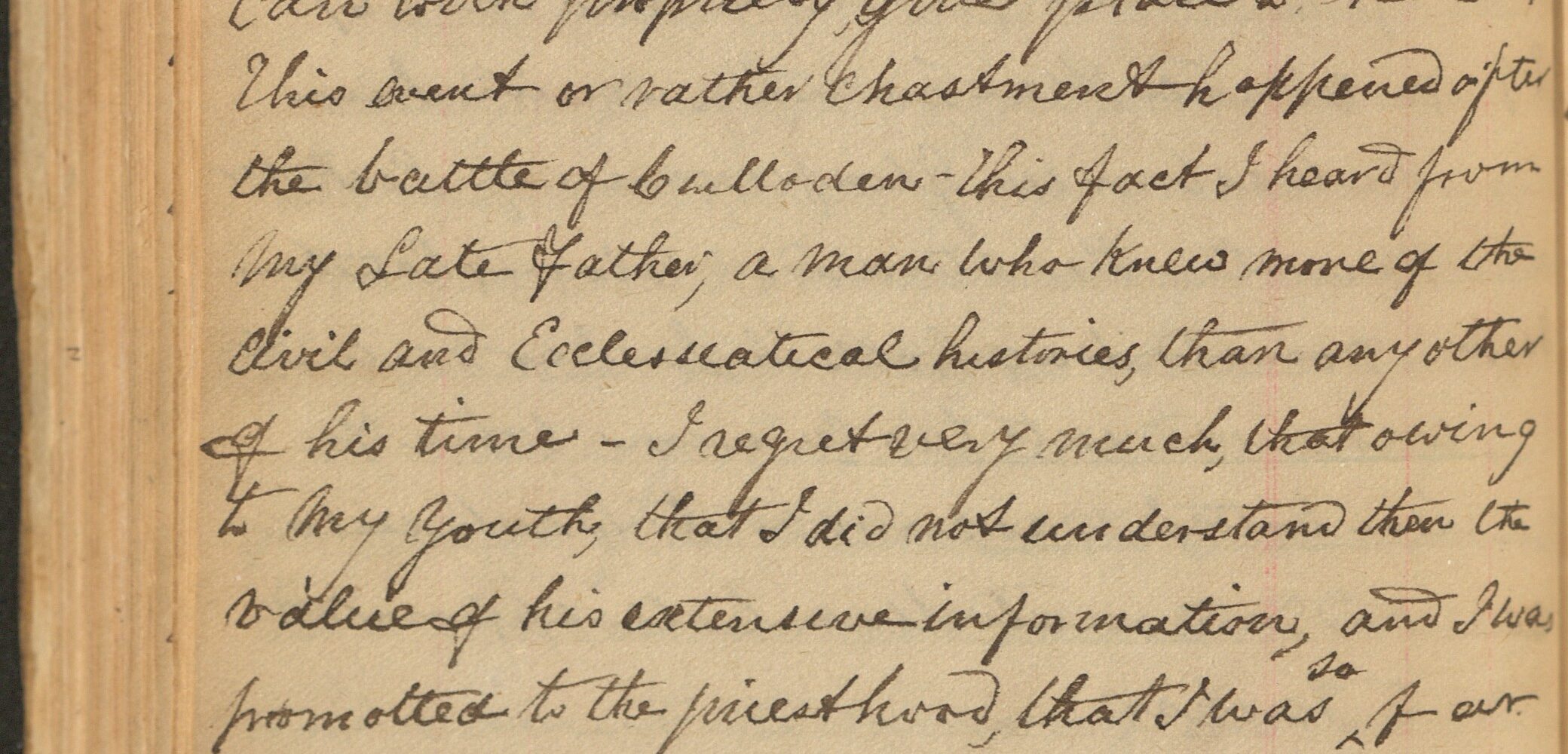
The mention of Fathers Forrester & MacDonald puts me in mind of an authentic event, which happened at this period in Uist, and I think I can with propriety give place to here. This event, or rather chastment, happened after the Battle of Culloden. This fact I heard from my late Father, a man who knew more of the Civil and Ecclesiastical histories, than any other of his time. I regret very much that owing to my youth, that I did not understand then the value of his extensive information, and [as] I was promotted [sic] to the priesthood, that I was so far situated from him that I could not consult on these to me interesting subjects.
After the disastrous Battle of Culloden, [a] great many soldiers were sent to Uist, in pursuit of the unfortunate Prince, who had not alone reason to fear their coming, but also the priests, in consequence of their well known loyalty and attachment to the House of Stewarts.
The barbarous system followed by these soldiers was not only to burn the house of such as they suspected to[o] friendly to the Prince, but also such as gave shelter to the priests came under their vindictive policy. If anything in such houses pertaining either to the priest or to the service of the altar was discovered, the penalty was, that the torch was applied to it. Mr James MacDonald, who was [at] the time in possession of the farm of Kildonan, had in his house all the requisite for celebrating Mass. The case was truly a desperate and a trying one. As the soldiers surrounded the house, there was not in the opinion of the inmates any possibility of removing them out of the house. In these straits, there was one courageous and cool headed man of the name of Niel Campbell (an ancestor of the writer) who dressing himself in tight pantaloons, with a great coat above them, managed to effect an entrance, where he found poor Mrs MacDonald in a distracted state, trying to conceal the vestments etc. in a wool bag. He without loss of time unscrewed the chalice, and puts the different parts of it into the legs of his pantaloons. The chasabil [sic] he secreted under his inner garments. The Alb and Missal he could conceal about his person without making his bulk suspected. His intentions were to come back for them again. When he came to the door, the two sentinals [sic] stationed there presented their bayonets. At this [he] opened his great coat and showed them that he had nothing then he was allowed to go out. He soon managed to hide his treasures in a cave called caraig a chait, near a stream well-known in the place named Ro-glas.
But ere he came back, with the intention of securing the Alb and Missal, the serching [sic] Party entered and soon discovered them. In regard to the first Article Mrs MacDonald strongly maintained, that it was one of her night shifts [nightdresses], and as to the Missal, that no-one knew how long it was in the house, amongst other books. The officer at the head as a matter of course did not believe her assertions, but likely he saw that he had no legal proof to carry matters to extremity. He however kept possession of the Alb, the book was pitched out amongst the soldiers, who at once cast it into the fire. When the sacred volume was nearly consumed one of the soldiers took it out of the fire and began to trample it under his foot, saying at the same time, the following rhyme in Gaelic. Dudie dudie, dadie dadie, cha bhith mi do chreidheamh an t-sagairt. An honest woman who was passing at [the] time, observing his action and listening to his saying, answered him in the same strains by saying Dudie dudie, dadie dadie, Cha bhith thu do chreidheamh an t-sagairt, ach tha do theanga dol a maillid, is tha do chas a dol am braisid.
Which words may render into English in this manner.
Soldier – ‘Dudie, dudie, dadie dadie, I will not be of the priest’s religion’ To which the woman answered ‘Dudie dudie dadie dadie you will not be of the priest’s religion, but your foot is getting quicker and your tongue is getting slower.’
This observation on the part of the woman was perfectly correct, for his tongue became paralised [sic] and the limbs of his body trembled all over. So that he was ever after [a] useless and disabled object, bearing the unmistakable punishment of divine vengeance for his impiety.
One would naturally imagine that so signal a punishment, as was inflicted on the above mentioned soldier, would open the eyes of the beholders to the danger of abusing holy things, but it seems not to have this effect, for the Captain at their head, on the Sunday following, put on the Alb (which he took from Mrs MacDonald) above his other garments, and thus arrayed marched through the Country. The poor people’s feelings were greatly hurt by so profane a display of impiety and intollerance [sic]. The day after this exhibition, the same officer in company with others went to the hills a deer stalking, where in an unaccountable manner, one of the guns carried by them discharged and shot him dead on the spot. I remember to have seen in the Library of Blairs College, one of the Bishop Geddes’ Manuscript, wherein was recorded that some chastments were inflected in Uist (at this time) upon the profaners of holy things. I am in manner since that the learned and good Bishop never heard the particulars, otherwise His Lordship would mention them.
After the departure of the hated red soldiers, as they were called, the Catholics of Uist were left unmolested and allowed to practice in peace, the tenets of their Holy Religion until Alexander MacDonald Esqr. of Boisdale began the persecution of the people on his property in the year 1770, but the narration of this sad event, deserves that a short chapter should [be] devoted [to] it.’
‘Chapter 5th The Capture of Mr Forrester and the Betrayal of Mr John MacDonald
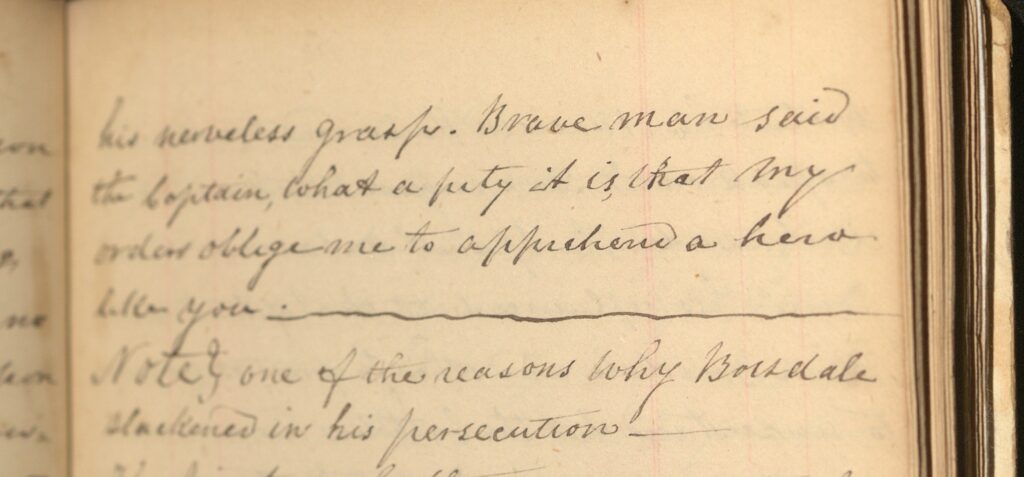
… It is a well known fact, that after the Battle of Culloden, the unfortunate Catholics of the Highlands had to undergo all sorts of trials and persecution. The priest[s], above all were marked out, as the objects of the Vengeance of the Government. A part of their order was to search strictly after missionary priests and if possible to apprehend them. Those of them who were drafted to Uist in Pursuit of the Prince, often behaved in a cruel and most disgraceful manner, but to enumerate even a few of their actions would take more time than I am disposed to give at present. It is true that there were some honorable exceptions amongst them, such as that of General Campbell, who put a stop to the burning of houses in the Long Island. It was no ways to be wondered at then, that in so minute and persevering a search, the poor priests could not escape being captured. Let the chances of escape be as they may, I am sorry to record that the capture of Father MacDonald was a real case of betrayal, and that also by a Catholic. This Judas like person came for the priest under the pretence that one of his Parishioners was in a dying state. Father MacDonald, expecting no evil, at once accompanied him, but upon their crossing the Ford, crossing the Howmore[?] river, they found some soldiers with a Captain at their head [on] their arrival. It was only then that he suspected the treachery of his companion and only said May God forgive you, your conduct is sinful and disgraceful. He saw at once that it was useless to attempt an escape and putting a bold front on, went forward, when the Captain presented two pistols to his breast, saying at the same time surrender. As quick as thought he rushed towards him and seized him by [the] wrists, giving him at the same time a good squeeze, which made his pistols fall to the ground from his nerveless grasp. Brave man, said the Captain, what a pity it is that my order[s] oblige me to apprehend a hero like you. …’
‘Father Forrester etc.
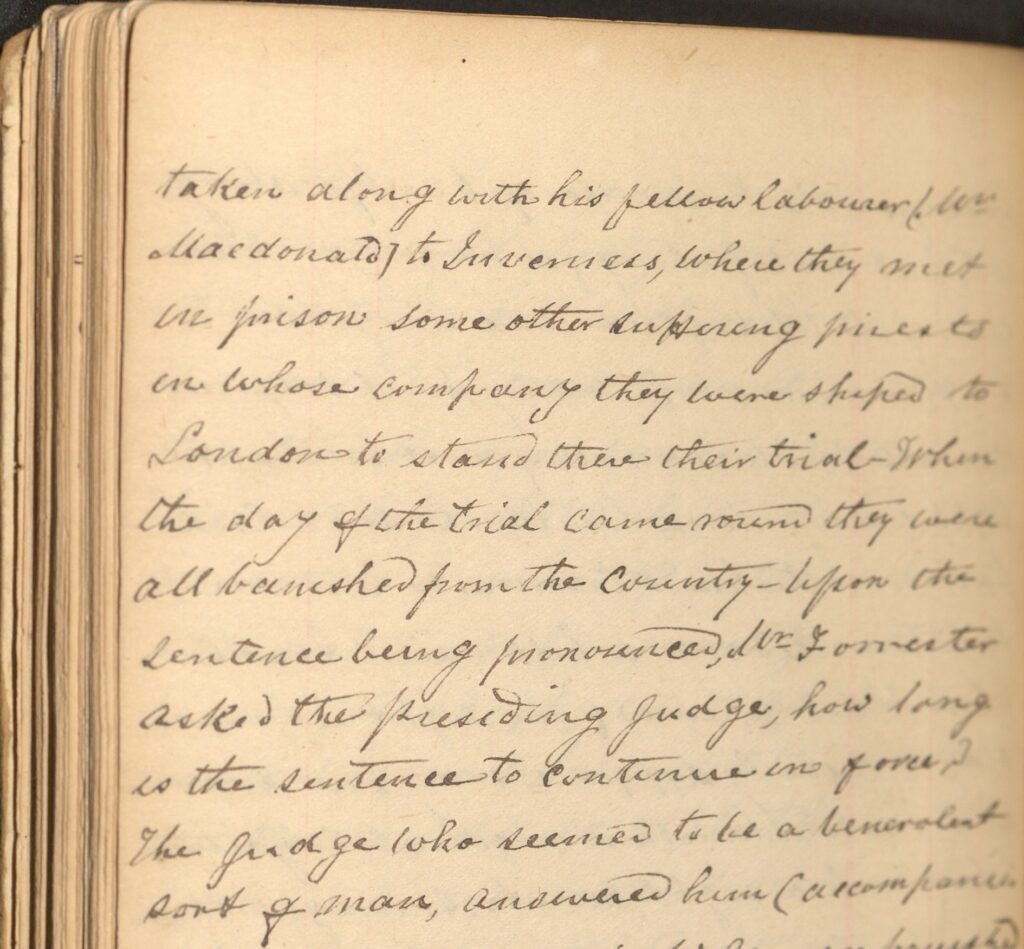
After a certain time of the Ecclesiastical history of Uist, Scotch priests began to fill the places previously occupied by the Irish. Amongst these Scotch priests were Fathers MacDonald and Forrester. The first was [as] already related, betrayed into the hands of the English followers of the Butcher Duke…. He [Father Forrester] continued to discharge faithfully his pastoral duties, until he was taken along with his fellow labourer (Mr MacDonald) to Inverness, where they met in prison some other suffering priests in whose company they were ship[p]ed to London to stand there their trial. When the day of their trial came round they were all banished from the Country. Upon the sentence being pronounced, Mr Forrester asked the presiding Judge, how long is the sentence to continue in force? The Judge, who seemed to be a benevolent sort of man, answered him (accompanied with a smile and a wink) You are banished and that is all I can tell you. He and his companions in misfortune were if [I] recollect properly, landed in Hol[l]and. As expected, the unjust sentence was disregarded by Mr Forrester, who in less than half a year, made his way back again to Uist. During his absence the large and populous mission of Uist was left destitute of spiritual succour, to the great grief of the faithful. I remember very well, when a boy, hearing from one of the name of Alexr. Ross, that during Mr Forrester’s banishment, a number of the people were assembled together in a certain house, where the priests vestments were kept, all of them were sad and not a few weeping, saying that they would never get another priest. Amongst these was one hoary headed Patriarch full of faith, who encouraged them by saying that God would not leave so large a flock without a guide and Pastor. Some were in hopes that such would be the case, others were in despairing mood, and whilst they were in this manner, taking different views of the subject, the bell kept with the vestment gave a lively ring. Do you all hear that said the old man, we will soon have mass. His opinion turned out to be correct, as Mr Forrester shortly after made his appearance…’
For more about the Priest’s Notebook and its conservation please return to this page.


