
Hebridean Emigration Resources
Introduction
People from the Outer Hebrides have emigrated all over the world over the last 300 years. For this reason, it is a vast research subject. This guide therefore lists just a few examples of sources on emigration which are particularly pertinent to the Outer Hebrides. It was compiled in the course of researching the exhibition Cianalas ’s Dòchas | Homesickness and Hope: Stories of Hebridean Emigration.
The numbers of people leaving the islands began to increase markedly from the 1750s. These early pioneer emigrants went mainly to North Carolina and New York State. The first documented emigrant ship to leave from the Outer Hebrides was the Alexander in 1772 carrying 210 passengers to Prince Edward Island. After the USA won its independence in 1783, Canada (or British North America as it was known at that time) became a more common destination for settlers.
Prince Edward Island, Nova Scotia and Cape Breton were the main settlements to begin with. Later, people went west – to the prairies of Saskatchewan and Manitoba, or to cities like Toronto, Winnipeg and Vancouver. Other destinations included the Eastern Townships of Quebec and Huron County, Ontario. These places, and more besides, are associated with settlers from the Outer Hebrides, including the Hudson’s Bay where many islanders found employment in the Fur Trade.
Emigration to Australia and New Zealand from the Outer Hebrides didn’t start until the 1850s when it was encouraged by organisations such as the Highlands and Islands Emigration Society. Victoria and New South Wales being two of the most popular states to settle in Australia. Whilst in New Zealand, Otago and Duneidin in South Island, and Waipu, Tauranga and Wanganui in North Island were popular destinations for emigrants.
From around 1900 South America needed shepherds for the huge ranches there and the Outer Hebrides became a labour source for this industry. The same was true for Detroit in the USA, which was known for it’s thriving motor industry with General Motors and Crysler factories attracting emigrants to relocate there for work.
During the 1920s, vast numbers left for new opportunities overseas, including young women, many of whom went to work in domestic service or as nurses. The most vividly remembered ships were The Marloch sailing from Lochboisdale to Saint John, New Brunswick in April 1923 with 280 emigrants from Benbecula, South Uist, Barra and Vatersay. Six days later the Metagama sailed, from Stornoway bound for Montreal with 312 emigrants from Lewis and 14 from Uist.
Resources
There are a wide range of resources available if you are researching this topic – see below to find information on Statistical Accounts, Napier Commission, Highlands & Islands Emigration Society, Cemetery Records, The Nicolson Institute Magazine, and the Tasglann nan Eilean Family History Guide.
Information on Particular Emigration Destinations can be found here; Canada, United States of America, South America, Australia, New Zealand
Statistical Accounts of Scotland
The first or ‘Old’ Statistical Accounts of Scotland (1791-1799) are among the best contemporary reports of life during the agricultural and industrial revolutions of Europe. They were the brainchild of Sir John Sinclair of Ulbster. Every parish minister in Scotland was asked to complete a report. The reports were rich and detailed, covering subjects such as agriculture, education, trades, religion and social customs. These Accounts can be used to study the factors which may have pushed people to emigrate in the late 18th century.
The New Statistical Accounts, published between 1834 and 1845, are also useful for documenting social and economic changes that had occurred between the publication of the Old and New reports. Both sets of Statistical Accounts have been digitised and are freely available and searchable online at: https://stataccscot.ed.ac.uk/
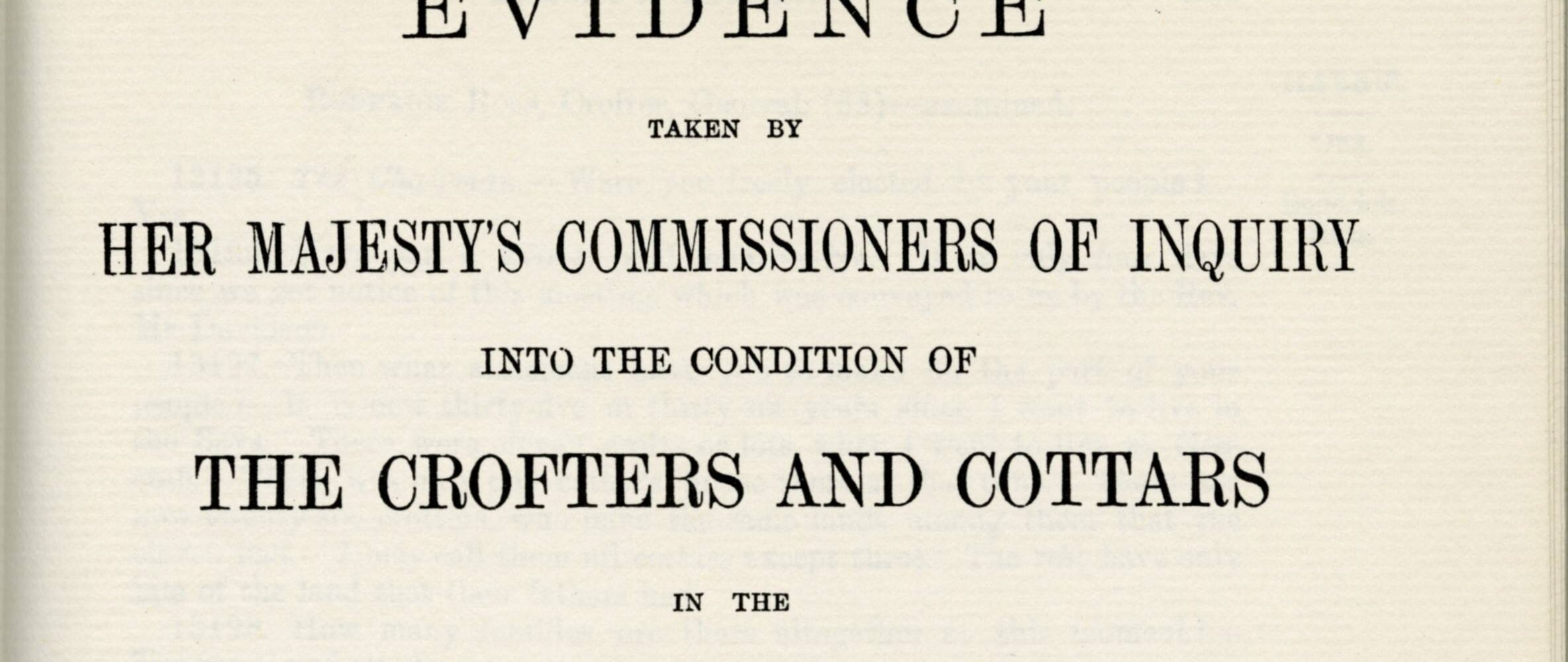
Napier Commission Evidence
Also known as the Royal Commission of Inquiry into the Condition of Crofters and Cottars in the Highlands and Islands. This Inquiry was set up by Parliament in response to land agitation and protest by crofters in the 1870s and 1880s. The Commissioners travelled round the islands taking evidence from crofters, landowners’ representatives, and others, to establish people’s grievances.
The evidence was published in 1884, in five volumes and is a highly significant source of information about social and economic conditions generally, including emigration events. It is direct testimony from the people themselves, and includes many references to crofters being cleared from their land and then being sent overseas by force. There are also claims from some of the witnesses that some chose to emigrate in search of better opportunities. The evidence led to the first Crofters’ Act of 1886.
This source is available online at: https://www.uhi.ac.uk/en/research-enterprise/cultural/centre-for-history/research/resources/the-napier-commission
Highland and Island Emigration Society
The Highland and Island Emigration Society was a voluntary organisation set up in 1852 – shortly after the potato famine which struck in the late 1840s – to assist people to emigrate, with the aim of relieving severe poverty. Between 1852 and 1857, the Society assisted nearly 5000 men, women and children to leave for Australia. Most of the emigrants were from Skye, Harris, St Kilda and Uist. HIES ship passenger lists have been digitised and are available to view on the Scotland’s People website, at: https://www.scotlandspeople.gov.uk/help-and-support/guides/highland-and-island-emigration-society-records.
This website tells the story of one infamous HIES voyage – that of the Hercules: https://blogs.slv.vic.gov.au/family-matters/the-voyage-of-the-hercules/
Cemetery Records
Cemeteries can be a useful source of information for ancestral research; inscriptions and images of gravestones are captured by websites such as:
Find a Grave: https://www.findagrave.com
Commonwealth War Graves Commission: https://www.cwgc.org/
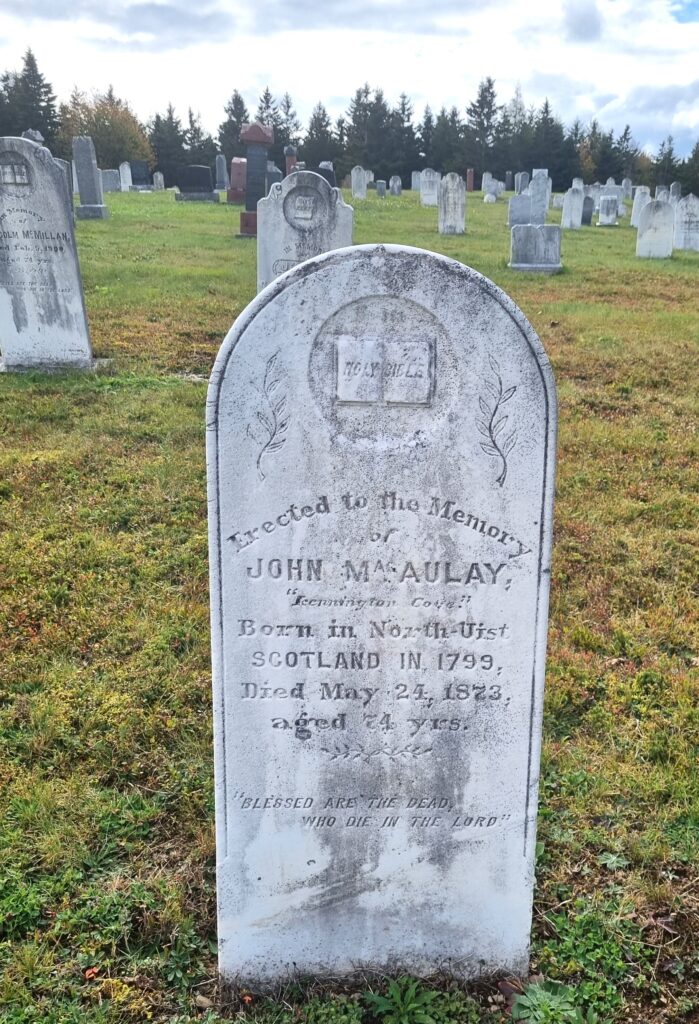
Gravestone of John MacAulay (1799-1873), a native of North Uist, in Loch End Cemetery, Catelone, Cape Breton, Nova Scotia
The Nicolson Institute, Stornoway: Records held by Tasglann nan Eilean
The annual magazines of the Nicolson Institute (the local secondary school in Stornoway) are a useful source for finding out about the varied careers pursued by island emigrants. The Magazine started around 1914. The ‘Jottings’ and ‘Obituary’ columns contain information about former pupils who had emigrated overseas. The 1936 edition contains an interesting account of educational Film Shows attended by pupils. These were supplemented by speakers from overseas. These illustrated to pupils the range of careers available overseas, or about life abroad, to encourage pupils to consider emigrating. Visit this page for more information.
Community Heritage Organisations
One of the legacies of the extensive emigration which occurred is the large number of people throughout the world who have connections to the islands. The Hebridean Connections database contains genealogical information relating to many of these families, drawn from the collections of local historical societies. The community heritage organisations throughout the Outer Hebrides are an excellent source of knowledge. Most, if not all, comainn eachdraidh (local historical socities) have gathered extensive information on those who emigrated from their area, and Hebrides People, located in Northton, Isle of Harris, specialises in genealogical research.
Family History Guide
Tasglann nan Eilean have produced a useful Family History Guide which pulls together information on a whole host of genealogical sources.
Download a copy of the Tasglann Family History GuideInformation on Particular Emigration Destinations
Canada
Baile nan Gàidheal Highland Village Museum
Baile nan Gàidheal is a living history museum and folklife centre that celebrates the story, language and living culture of Nova Scotia Gaels and the legacy of the Hebridean diaspora. https://highlandvillage.novascotia.ca/
General reading on Highlands & Islands emigration to Canada
- Ian Adams and Meredyth Somerville, Cargoes of despair and hope : Scottish emigration to North America, 1603-1803(John Donald, 1993)
- John L. Campbell (editor), Songs remembered in exile : traditional Gaelic songs from Nova Scotia recorded in Cape Breton and Antigonish County in 1937 with an account of the causes of Hebridean emigration, 1790-1835 (Birlinn, 1990 (2nd edition))
- Karly Kehoe,“A colony to themselves” : Scottish Highland settler colonialism in British North America, 1770–1804 (Journal of British Studies, volume 63, issue 3, July 2024, pp. 588-605)
- Archibald J. MacKenzie and Archibald A. MacKenzie, The MacKenzies’ History of Christmas Island Parish. The original 1926 edition by A.J. MacKenzie revised and updated by his son A.A. MacKenzie; A historical and genealogical account of Christmas Island Parish, Cape Breton, Nova Scotia which was mainly settled by emigrants from the Isle of Barra; includes oral history (in both English and Gaelic), Gaelic lyrics and music, a map, and several illustrations. (MacKenzie Rothe Publishing Partnership, Ontario, 1984)
- Kathleen Toomey, Emigration from the Scottish Catholic bounds, 1770-1810 and the role of the clergy (University of Edinburgh Press, 1991)
- Jim Wilkie, Metagama: A Journey from Lewis to the New World (Mainstream Publishing, 1987)
Works on Specific Aspects of Emigration to Canada
Language and Culture
Michael Newton (editor), Seanchaidh na coille / The memory-keeper of the forest (Cape Breton University Press, 2015)
This anthology of Gaelic poetry and prose literature showcases the experiences of Gaels in Canada. Newton explains that the Gaelic title seanchaidh has no exact equivalent in English. A seanchaidh is a professional custodian of seanchas: communal memory, history and experience. He also explains that the image of the forest is a dominant one in Gaelic diaspora literature which refers to North America and Canada as “Dùthaich nan Craobh” (The land of trees) and “A’ choille ghruamach” (The gloomy forest).
Along with English translations and information on biographical, historical, socio-cultural and literary contexts, this anthology covers many themes including migration, settlement, love and death, religion, language and literature, identity, and politics.
You can hear Michael Newton discussing his research processes and sources in this interview for the Canadian Broadcasting Corporation: https://www.cbc.ca/player/play/audio/1.3348864
Roderick Mackenzie – Research on Indigenous People’s Languages
Roderick Mackenzie, born in Ross-shire, was a cousin of the famous explorer Sir Alexander Mackenzie, and it is believed he was brought up with him in Stornoway during part of his youth. Inspired by the example of the Statistical Account of Scotland, Roderick conducted a Survey of North-West Canada in 1806.
As a partner in the North West Company (NWC), he had a lot of contact with Indigenous Peoples through the fur trade. He issued a printed Circular to the ‘Indian Traders’ in the NWC asking for an ‘Account of their respective Indians’.
An interesting and valuable aspect of this survey was the provision of a list of words for which he wished each trader to supply the equivalents in the languages of the Indigenous Peoples living in their area. The responses comprise the major part of the Masson collection now in McGill University Library, Montreal, Canada. http://digital.library.mcgill.ca/nwc/toolbar_1.htm
Prince Edward Island, Canada
- J.M. Bumsted, Settlement by Chance: Lord Selkirk and Prince Edward Island (Canadian Historical Review, volume 59, number 2, pp. 170-188, June 1978) https://utppublishing.com/doi/10.3138/CHR-059-02-02
- J.M. Bumsted, Captain John MacDonald and the Island (The Island Magazine (Prince Edward Island Museum), number 6, spring/summer 1979) https://hp1.islandarchives.ca/islandora/object/vre%3Aislandmag
- Mike Kennedy, Is leis an Tighearna an talamh agus an lan (the earth and all that it contains belongs to God) : the Scottish Gaelic settlement history of Prince Edward Island (University of Edinburgh doctoral thesis, 1995) https://era.ed.ac.uk/items/cf4b2c43-3945-4a47-b1ec-48c046938afe
- James P. Lawson, Passengers on the Alexander (The Island Magazine (Prince Edward Island Museum), number 29, spring/summer 1991) https://hp1.islandarchives.ca/islandora/object/vre%3Aislandmag
- The Glenaladale pioneers https://www.electricscotland.com/history/articles/glenaladale_pioneers.htm
Hudson’s Bay Company
Angus Macdonald, Pemmican and portages : the Isle of Lewis, the fur trade and the Hudson’s Bay Company (Islands Book Trust, 2025)
Drawing on personal testimonies, this book tells the stories of the hundreds of Lewis men involved in the North American fur trade and Arctic exploration during the 19th century.
Philip Goldring, Lewis and the Hudson’s Bay Company in the Nineteenth Century (Scottish Studies, Volume 24, 1980); Lewis and the Hudson’s Bay Company in the Nineteenth Century | Scottish Studies
Isle of Lewis settlement in Ontario, Canada and the Eastern Townships of Quebec
Margaret Bennett, Oatmeal and the catechism: Scottish Gaelic settlers in Quebec (John Donald, 2003)
Margaret Bennet, From the Outer Hebrides to the Eastern Townships of Canada in the Nineteenth Century (Journal of Eastern Townships Studies) JETS_46-11_Bennett.pdf
Quebec Anglophone Heritage Network articles including story of ‘The Megantic Outlaw’: On the Trail of the Scots, Part 1 | QAHN ; On the Trail of the Scots, Part 2 | QAHN ; Donald Morrison’s Defence Fund | QAHN
Leodhas Macleod / Angus Macleod: Genealogy service and publications on clearances, cemetery inscriptions and township records relating in particular to Lewis emigrants who settled in Eastern Townships of Quebec and Ripley, Ontario (Huron Township) https://www.hebrides.ca/
United States of America
Many of the men who left in the early 19th century to work in the Hudsons Bay fur trade ended up subsequently migrating to the USA.
Later, in the 1920s, many left the Outer Hebrides under government emigration schemes. They were supposed to settle on farms in Canada in order to repay part of the cost of their fare. Instead, many migrated illegally to the USA for better paid employment in factories, mines and other industries. The ‘Marloch’ and the ‘Metagama’ were only two examples of the many ships which left for Canada at this time.
Lewis Society of Detroit archive records, held by Tasglann nan Eilean
The Lewis Society of Detroit, USA, was founded in approximately 1919 to enable those with connections with the Isle of Lewis, Scotland, who were living in Detroit to meet together for social events and to “foster and preserve the language, traditions, customs and amusements of the people.”
http://ica-atom.outerhebridesheritage.org.uk/index.php/lewis-society-of-detroit-1919-1972;isad
The minute books and subscription records of the Lewis Society of Detroit have now been digitised and are available here.
South America
- Greta Mackenzie, Why Patagonia (Stornoway Gazette, 1996 (2nd edition))
- Greta Mackenzie, Return to Patagonia (Islands Book Trust, 2010 (2nd edition))
Mackenzie’s first book ‘Why Patagonia?’ told the story of the many island people who sought employment on the vast sheep estanchias of Patagonia, and elsewhere throughout the South American continent, in the early years of the 20th century.
In ‘Return to Patagonia’ – an updated and extended version – the author returns to the subject, detailing the incredible history and enduring links between the Outer Hebrides and Patagonia.
This, and many other interesting local historical publications, are available from: https://islandsbooktrust.org/
Australia
As well as the records of the Highland and Island Emigration Society, the following are useful resources for Hebridean emigration to Australia:
State Library of Victoria: Tells the story of the voyage of HMS Hercules which carried 756 emigrants from Harris and North Uist and took 8 months to make the crossing in 1852 resulting in severe suffering and deaths enroute. State Library Victoria – The voyage of the Hercules
White Hut Gaelic Cemetery, Clare, South Australia. This cemetery is approximately 90 miles north of Adelaide. It is on land which was set aside in 1860 by John MacAskill (1821-1893), from North Uist, for the Gaelic-speaking pioneers who arrived on the Hercules, and their families and descendants: https://www.findagrave.com/cemetery/2638073/white-hut-gaelic-cemetery
Eric Richards, The Highland Scots of South Australia (Journal of The Historical Society of South Australia, number 4, 1978, pp. 33-64) https://historicalsocietysa.com/wp-content/uploads/2020/03/Number-4-1978.pdf
The Genealogical Society of Victoria https://www.gsv.org.au
Journal of Murdo Morrison’s voyage from Greenock to Australia to take part in the Gold Rush of 1852. This has now been digitised and is available here.
New Zealand
Gaelic Society of New Zealand: records held by the University of Otago
The Gaelic Society of New Zealand was founded in 1881. Its main objectives were to foster and uphold the customs, traditions, language, literature, stories, music and songs from the Scottish Highlands. https://hocken.recollect.co.nz/nodes/view/60887
Jennifer Jane Ann Colman, Transmigration of the Piob Mhor : the Scottish Highland piping tradition in the South Island of New Zealand, with particular reference to Southland, Otago, and South Canterbury to 1940 (University of Otago doctoral thesis, 1993) https://ourarchive.otago.ac.nz/esploro/outputs/doctoral/Transmigration-of-the-Piob-Mhor/9926479538401891
Evelyn Ruth Entwhistle (ed.) History of the Gaelic Society of New Zealand 1881 – 1981 (Self-published, Dunedin, New Zealand 1981)


